
Blog
Why does the listed price rarely show the real laser cutting machine cost?
A quote is only the starting point. The real laser cutting machine cost is shaped by ownership, uptime, and output over several years.
That matters even more when comparing a standard unit with an OEM CO2 laser machine or a custom CNC CO2 laser cutting machine.
In practice, two machines with similar purchase prices can create very different monthly expenses.
One may use more power, need more tube replacements, or stop production more often. The other may run steadily and waste less material.
For budget planning, the better question is not, “What does it cost today?” It is, “What will it cost per productive hour?”
A CO2 laser cutting machine also sits inside a wider workflow. Software, extraction, operator time, spare parts, and maintenance all influence total cost.
If the machine is also used for engraving or marking, the cost picture changes again because job mix affects wear, speed, and labor allocation.
So before approval, it helps to break the decision into several cost layers instead of relying on the sticker price alone.
Which cost items usually have the biggest impact after installation?
The largest expenses are usually not hidden, but they are often underestimated during comparison.
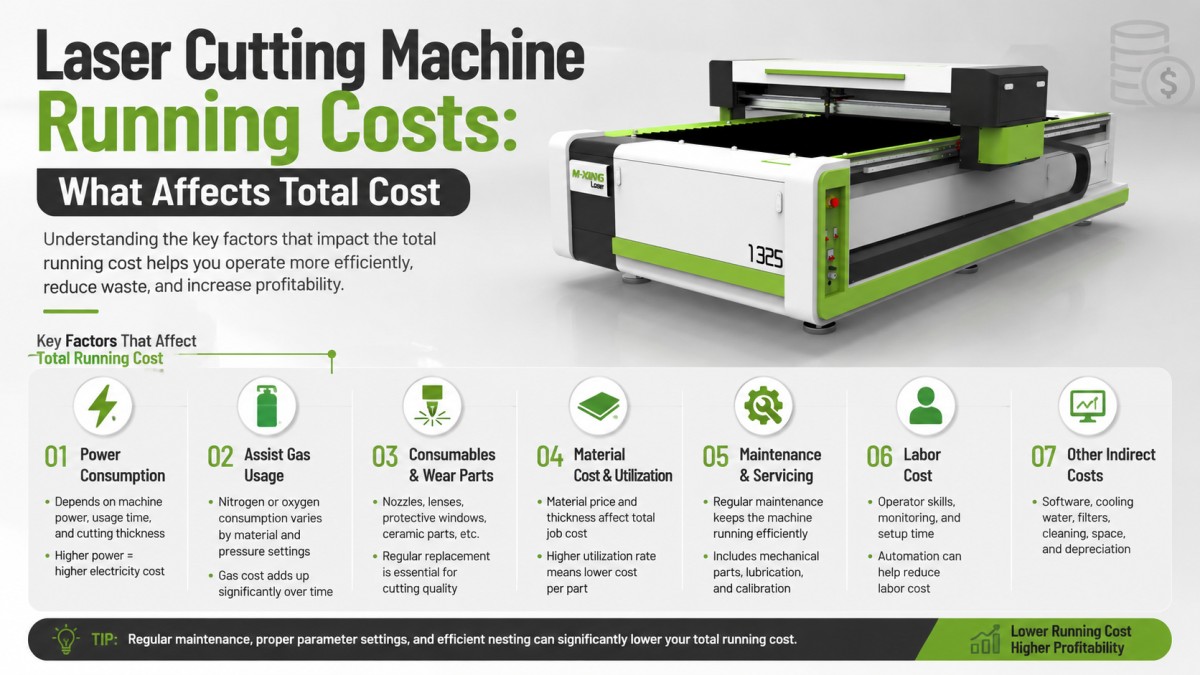
For a laser cutting machine, the main ongoing cost drivers usually include the following:
- Electricity consumption from the laser source, chiller, exhaust, and air assist system.
- Laser tube or core component lifespan, especially for CO2 laser machine configurations.
- Optics, belts, lenses, mirrors, filters, and routine consumables.
- Software licensing, file processing, and controller compatibility.
- Operator setup time, training, and error-related scrap.
- Downtime caused by slow service response or difficult spare part sourcing.
Power use looks small on paper, yet it accumulates daily. A machine running multiple shifts can create a very different annual utility bill.
Tube lifespan is another key variable. A lower upfront quote may depend on shorter-life components, which changes replacement frequency and service interruption.
More common than expected is the labor cost tied to inconsistent cutting quality.
If operators repeatedly adjust focus, recut parts, or clean edges, the laser cutting machine cost rises through lost time rather than invoices.
This is why many buyers ask not only for a machine price, but also for an expected annual running-cost estimate.
How can you compare machines without missing hidden expenses?
A practical comparison should look beyond model labels and wattage. The goal is to compare cost behavior, not just equipment specifications.
One simple way is to use a cost review table before any final approval.
This kind of comparison is especially useful when evaluating a supplier offering both CO2 laser engraving machine and CO2 laser cutting machine options.
The machine with better workflow integration may carry a higher quote, yet lower the total laser cutting machine cost over time.
A helpful test is to ask for sample production based on your own materials, thicknesses, and file types.
That usually reveals real speed, edge quality, and operator effort faster than a brochure can.
Does a cheaper CO2 laser machine always save money?
Not necessarily. Lower purchase cost can be a good decision, but only when the machine matches the workload and support needs.
A lower-cost laser cutting machine may still work well for lighter duty, short shifts, or stable materials.
The risk appears when low entry price is paired with heavy production expectations.
For example, a machine used for continuous acrylic, wood, leather, or packaging work may need stronger cooling stability and better parts consistency.
If not, maintenance frequency climbs and output quality becomes less predictable.
This is also where supplier depth matters. A factory focused on wholesale CNC CO2 laser machine systems may support parts continuity better than a trader with changing configurations.
The same applies to OEM CNC CO2 laser cutting machine projects. Customization can improve fit, but it should not create dependence on rare components.
A useful rule is simple: a cheaper machine saves money only if it keeps quality stable, service manageable, and throughput close to plan.
If any of those fail, the initial savings disappear surprisingly fast.
What mistakes make the total cost rise faster than expected?
Several common mistakes do not look serious during quoting, yet they often push ownership cost higher.
- Choosing power based on marketing language instead of actual material range.
- Ignoring ventilation, cooling, and installation conditions at the site.
- Assuming all software and controllers work smoothly with existing design files.
- Skipping questions about consumable pricing and replacement intervals.
- Underestimating training time for operators and maintenance staff.
- Comparing only machine quotes, not annual cost per output unit.
Another mistake is treating all applications as equal. A CO2 laser marking machine, engraving system, and cutting platform can share technology, but cost behavior differs by task.
When mixed jobs are expected, utilization planning becomes more important than raw speed.
It is also worth checking whether a supplier can support future scaling.
If volume grows, an undersized machine may force overtime, subcontracting, or early replacement, all of which inflate the original laser cutting machine cost assumption.
So what is the smarter way to approve a laser cutting machine investment?
The strongest approval decisions usually come from a short list of measurable checks, not from the lowest quote.
Start by defining expected materials, thickness range, daily running hours, and acceptable quality tolerance.
Then ask each supplier to map those needs to estimated power use, tube life, maintenance intervals, and service commitments.
If the supplier also produces CO2 laser engraving machine and CO2 laser cutting machine lines, that broader manufacturing background can help when matching the right platform to the workload.
A sensible approval checklist often includes these points:
- Estimated yearly operating cost, not only acquisition cost.
- Expected productive hours before major component replacement.
- Sample output quality on real jobs.
- Availability of parts, training, and remote support.
- Compatibility with future volume or OEM customization needs.
In the end, the real question is not whether a laser cutting machine is cheap or expensive.
It is whether the machine can control waste, maintain uptime, and produce reliable output at a predictable cost.
That is the basis for a sound investment decision.
The next useful step is to build a side-by-side ownership model for two or three options, using your own materials, shift pattern, and maintenance assumptions.
Once those numbers are visible, the right laser cutting machine choice usually becomes much clearer.